# Kwangjai Park
A.B. (1958), Ph.D. from University of California, Berkeley (1965)
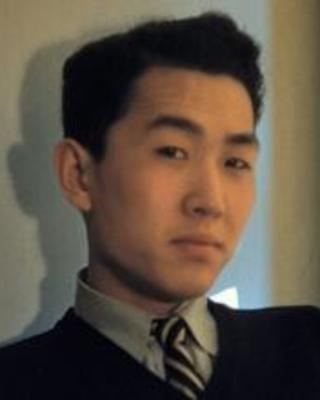
Kwangjai Park (Pak Kwang-jae, 박광재 朴光在, 1934–2014), one of the earliest Koreans who received a bachelor’s degree from Harvard College, was a professor of physics at the University of Oregon.1 Kwangjai Park was born on October 12, 1934, in Wŏnsan, South Hamgyŏng Province, in Japanese-occupied Korea. The son of devout Christians, Park enrolled in a Japanese elementary school called *sohakkyo* (小學校) that usually only accepted Japanese students rather than attending an ordinary school for Koreans because his maternal aunt was an influential civic leader at the time. His father’s privileged position as one of the highest-ranking Korean office staff at a mining company later allowed Park to also attend another Japanese-only school called Sinasan sohakkyo (新阿山 小學校) in Sŭngnyang (承良) near Kyŏngwŏn, North Hamgyŏng Province. Park’s family later relocated to Beipiao (北票) in western Manchuria in early August of 1945 due to his father’s role with the mining company. Soon after, however, upon the defeat of Japan in WWII and the start of the Chinese Communist Revolution, Park’s family began a nearly year-long journey in October 1945 to return home to Korea.
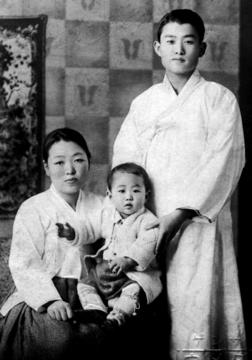
First birthday. *Family Stories* by Kwangjai Park, p. 19.Although Park family’s household registry (*hojŏk* 戶籍) was established in Kyŏngwŏn, Park’s father intentionally listed his brother’s address in Seoul in the identification documents during the family’s plight as refugees. This strategy allowed for his family to safely reach South Korea and escape from the persecution against “pro-Japanese” Koreans that former colleagues of his father suffered in the communist controlled North Korea. After settling in Seoul and resuming sixth grade, Park became a top elementary school student and was accepted in 1948 as one of the 300 50th graduating class of the Kyŏnggi Middle School (京畿中學校) or Number One High Level Ordinary School (第一高等普通學校), which was known as one of the oldest and most prestigious middle schools in Korea at the time. At Kyŏnggi, Park experienced a highly militarized school system reminiscent of the Japanese colonial era, in which the student body was referred to as a “Battalion,” each grade was a “Company,” and each homeroom was a “Squad.” Park along with classmates was required to wear a militaristic uniform including a cap with school insignia and to salute any upperclassmen he encountered from the school.
In June 1950, during Park’s third year at Kyŏnggi, the Korean War broke out, resulting in his family becoming refugees once more and moving between Pusan and Seoul in tandem with U.S. military movements during the war. Unable to attend school, Park worked for the U.S. military during the war, starting as an errand boy for the Motor Pool Section of the 59th Military Police Company and going on to serve as an official interpreter for the 724th Transportation Railway Operating Battalion.
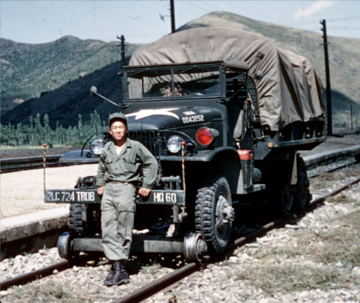
Park and truck-train. Family Stories by Kwangjai Park, p. 49.Several U.S. Army personnel whom Park worked for during the war inspired him to pursue education in the United States. Most of all, Sergeant Bob Long from Harrisburg, Pennsylvania, who talked a lot about Korea’s need for engineers and scientists to rebuild the country, motivated Park to study an engineering field later. Toward the end of the war, Park resumed his studies at Kyŏnggi, where he noticed sons of powerful families pursuing education abroad probably to escape from the army draft. Following in his classmates’ footsteps, Park by July 1953 became the 2332nd person to receive a passport from the Republic of Korea and departed on a transpacific flight to California via Tokyo, Wake Island, and Hawaii. Arriving in the U.S. later that month, Park worked as a busboy and later a night desk clerk for Pebble Beach Lodge while simultaneously attending Monterey Union High School.2 In March 1954, Park received an offer from Harvard College for its Class of 1958 with a full scholarship, which included tuition, room and board, and stipend. Park accepted it given that it was the best scholarship offer he received from the more than 50 colleges and universities he applied to. By summer of 1954, Park had saved enough money to purchase a car, and in August, he drove himself across the country to Cambridge, MA.
During his four years at Harvard, Park took courses from various distinguished faculty including the renowned cultural anthropologist [Clyde Kluckholn](http://www.nasonline.org/publications/biographical-memoirs/memoir-pdfs/kluckhohn-clyde.pdf) (1905–1960), the Novel Laureate [Edward Purcell](https://www.nobelprize.org/prizes/physics/1952/purcell/biographical/) (1912–1997), the famous Sinologist [John F. Fairbank](https://fairbank.fas.harvard.edu/person/john-k-fairbank/) (1907–1991), and [Edwin O. Reischauer](https://rijs.fas.harvard.edu/edwin-o-reischauer) (1910–1990). He held multiple part-time jobs during college, including parking cars in a Boston garage, cleaning dorm rooms over winter break, as well as working as a gas station attendant and a student technician for the [Cambridge Electron Accelerator](https://www.thecrimson.com/article/1958/10/16/an-mit-harvard-project-the-electron-accelerator/) project, then the world’s highest-energy electron accelerator. At Harvard, Park found himself having to abide by arcane rules, such as the requirement to wear a coat and a tie for eating meals at the Freshman Union. During his freshman year, he seemed to have volunteered at the [Phillips Brooks House](https://publicservice.fas.harvard.edu/pbha) and spoke on his impressions of America at an event celebrating Thanksgiving.3 During his first two years at Harvard, Park had Rodney Carlisle, a classmate from Monterey Union High School, as his roommate. Park as a foreigner and Carlisle from a middle-class family and a “non-conformist” were “a new breed of Harvard students,” who were recruited to Harvard thanks to President James Bryant Conant’s (1893–1978) policy to “democratize” Harvard.4 Later, as an upperclassman, Park went on to be housed in Leverett House.
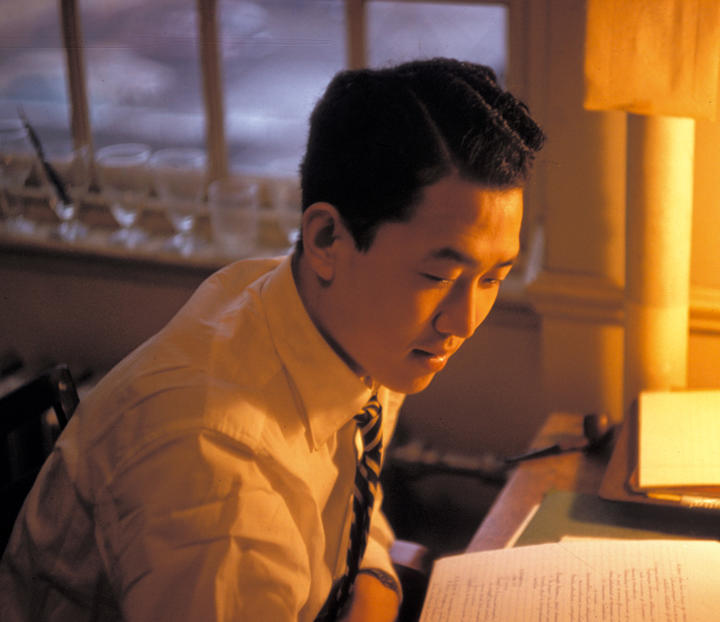
Park reading in his dorm room. Courtesy of the Park family. 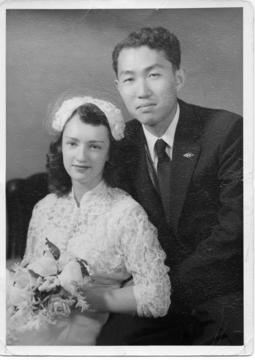
Park and Marcia. Courtesy of the Park family.In October 1956, Park began a relationship with a young woman named Marcia Sherman at the Church of New Jerusalem, the Swedenborgian Church in Boston, where he attended regular Sunday services. Soon, Park moved in with Sherman, whom he married in April 1957. The couple moved to Watertown, from where Park commuted to Cambridge for the remainder of college. By 1958, Park graduated from Harvard *cum laude*, majoring in Engineering and Applied Physics. After a brief two-month position at Boston College, which offered Park graduate admission, he and his wife along with their newborn son moved to Santa Ana, California, where Park started a junior engineer position in a private research company Plasmadyne.
After a few years of industrial job experience and the birth of his daughter, Park moved his family to Berkeley where he began a graduate program in physics in September 1961 and had the fortune of working for a new assistant professor named [John J. Hopfield](http://pni.princeton.edu/john-hopfield). Park worked in the physics lab where he assisted with tasks ranging from set-up and maintenance of apparatus to data collection. Together with Hopfield and J. M. Worlock, Park co-authored the paper “Two-Quantum Absorption Spectrum of KI,” which has come to represent a renowned classic physics experiment.5 Bolstered by the expertise gained working for Hopfield’s laboratory and by the funding allotted by the U.S. government toward attaining scientific and engineering superiority over the Soviet Union with the start of the Space Race following Sputnik’s success, Park proceeded to complete his Ph.D. dissertation on “The Excited States of F-Centers in Potassium-Iodide” in only three and a half years. Upon completing his Ph.D., Park received an offer from Bell Telephone Laboratories and moved with his family to Summit, New Jersey in May 1965, though he ultimately returned to academia by securing a two-year research grant from the US Army Research Office and a position at the University of Oregon, which granted Park an indefinite tenure in 1972.
Earlier on when Park was in southern California, he had initially discovered his passion for teaching in his role as a part-time instructor for the Industrial Engineering Program at Orange Coast College in Costa Mesa where he taught an evening course in introductory physics. He also taught a large, two-year course on electronics sequence whose students aspired to be aerospace technicians. At University of Oregon, Park brought his love for the teaching profession as well as his ideas for potential new pedagogical innovations. Inspired by a three-day conference he attended in Seattle called “Greening Physics” in 1970, Park proposed new changes to an unpopular university curriculum that traditionally offered only a “Physical Science Survey” course as part of the science component of its general education requirements. Despite reservations of other faculty members, Park’s experimental new course called “Physics of Sound and Music” became incredibly popular even with non-STEM students, with enrollment needing to be capped at 90 students and the course coming to be mentioned in local newspapers as well as by the Associated Press. Park’s department soon followed his model, with its curriculum committee voting to establish structured “minicourses” similar to Park’s experimental course that would be offered each term instead of the former year-long “Physical Science Survey” course. By 1972, Park received the [Ersted Award for Distinguished Teaching](https://provost.uoregon.edu/distinguished-teaching-awards) in recognition of his work.
In August 1972, nearly 20 years since his departure from Korea, Park arrived in Seoul where he took a sabbatical leave. He received a US AID grant under a program named “Scientists and Engineers for Economic Development,” with which he intended to make some meaningful educational contributions in Korea. He was affiliated with Sogang University where he started several projects including the new laser physics program. During his stay in Korea, Park witnessed firsthand how the Yusin system penetrated into everyday lives of Korean people and compromised people’s liberty. In the summer of 1974, Park visited Korea again as the Korea Institute of Science and Technology invited him to work as a summer consultant for their laser program.
After several years of hiatus in terms of his research due to personal reasons, Park moved to a new research field of fluid physics, which had interested him when he worked at Plasmadyne, and began publishing in that field from 1980. By 1982, he secured independent research funding from the National Science Foundation. Park went on to publish twelve journal papers, gave nine papers/seminars at universities and NSF meetings, and helped advise a few students in the field between 1980 and 1986. In 1986–1987, Park took a sabbatical leave to work at the National Institute of Standards and Technology in Boulder, Colorado, which in turn led him to join an international collaboration team in studying atmospheric ozone depletion in 1988. NASA funded this research area for fourteen years until his retirement from University of Oregon, which enabled him to publish fourteen papers. He also worked as a consultant for various businesses, through which he came to be familiar with other fields such as space engineering and information technology while making contributions to solving engineering problems in these fields.
In spring 2003, Park retired from the University of Oregon after 36.5 years of teaching and research. Upon retirement, Park devoted to spending time with family, traveling, and writing his personal memoirs. On March 21, 2014, Park passed away, survived by his wife Helen, five children, nine grandchildren, and two great-grandchildren.
When he initially left war-torn Korea in 1953 with a student visa, Park envisioned that he would eventually return to his home country. By the time he graduated from Harvard, however, the overall political and socioeconomic situation in Korea seemed unstable and his beloved field of science and engineering appeared to offer limited prospects in Korea. Therefore, Park stayed in U.S. to develop his career and soon became a naturalized U.S. citizen on November 19, 1961. Despite adopting a new country and facing challenges posed by what some viewed as a complicated Korean name, he chose to retain the name “Kwangjai” given to him by his father, determining it “good enough to last a lifetime.” Other members of Park’s family eventually also immigrated to the U.S. one by one following in his footsteps. Park’s youngest brother, who was the first to come, arrived in fall 1975 and initially worked at a gas station. Later that same year, Park’s sister emigrated to Eugene with her husband and two children, with the husband taking a job at a can manufacturing plant. Park’s parents followed suit in October 1976, moving to Eugene to live at Park’s house. Park’s middle brother also emigrated to the U.S. and settled in Anchorage, Alaska where he started working as a surveyor for the Alaska Highway Department before becoming a junior engineer for offshore drilling operations and worked his way up to becoming Manager of U.S. Domestic Drilling Operations for Atlantic Richfield Company. The last of Park’s family to emigrate was his second youngest brother, who moved to Eugene with his wife and three children and went on to establish an Asian grocery store as well as a convenience store. In his memoir, Park writes with pride of the twelve children across Park and his siblings who constitute the second-generation of Park’s family in the United States, for every one of them endured cultural challenges and nonetheless “thrived and excelled in schools, attended colleges and universities, and is leading a productive life.”
Written by Young Jun Andrew Kim, 05/18/2022
1 This biography is largely based on Kwangjai Park’s self-published autobiographical work titled *Family Stories* (3rd edition, 2012). We like to thank Melora Park, one of Park’s children, who provided us access to her personal copy of the book.
2 There were other Korean students at the same high school at the time. Yersu Kim, who was also a Kyŏnggi student, came to US to study at Monterey Union High School from January 1953 to 1955. He went to Harvard College as well as a Class of 1959. See Yersu Kim, “Kiŏk ŭi p’yŏllin (1): hoegorok” (A Glimpse of My Life: A Memoir), *Ch’ŏrhak kwa hyŏnsil* (2021), 193–219.
3 See “P.B.H. Will Present Shows for Holiday,” in *The Harvard Crimson* (November 24, 1954). .
4 Conant served as the 23rd President of Harvard University from 1933–1953. See “History of the Presidency,” Office of the President, Harvard University. . For one of the news coverages on Conant’s presidency, see “James Bryant Conant: The chemist as President, the President as Defender of the Free University,” by Michael J. Halberstam appeared in *The Harvard Crimson* (September 15, 1952). .
5 This paper was published in *Physical Review Letters*, Vol. 11 (9) (Nov. 1963): 414–417. .
*The Harvard Korean Alumni Biographies Project and the Project website are copyright © 2024 President and Fellows of Harvard College and/or its licensors. Unauthorized reproduction or distribution is not permitted.* *Please contact Executive Director Susan Laurence (*[*susan\_laurence@harvard.edu*](mailto:susan_laurence@harvard.edu)*) for any concerns or questions*.
- ## Decade
[1950-1960](/decade/1950-1960)
- ## Korean Alumni
[Harvard College](/korean-alumni-decade/harvardcollege)