# No-Yong Park
A.M. (1930), Ph.D. (1932)
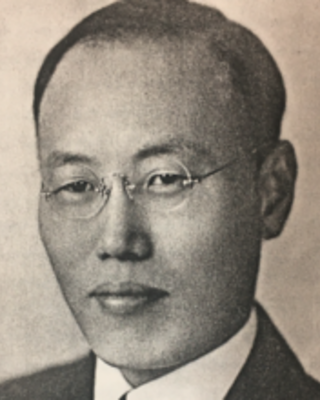
*Portrait of Park No-Yong from Lanhei Kim Park's book. Courtesy of Lanhei Kim Park and Mei-Lan Shaw.*
No-Yong Park (1897 or 1899–1976), or Pak No-yŏng (박노영 朴魯英), was a Korean-born activist who, upon arrival in the United States, became a self-proclaimed Chinese immigrant lecturer and writer.1 Park also has the distinction of being one of the first Koreans to have received a PhD from Harvard University. Park gained fame and rare prominence for an immigrant from Asia for his informative and witty lectures on Asia- and China-related topics from the 1920s until his death in 1976. Park also published several well-received books on topics ranging from history and international politics in Asia to an autobiography that covered his experiences living in America.
Park has long been known as a prominent Chinese American immigrant writer and scholar. However, it has now become clear that he was not only of Korean descent, but spent many of his formative years in Korea, rather than in China as he claimed. Indeed, the question of whether he was primarily of Chinese or Korean background permeates any discussion about Park, whose self-identification as Chinese was central to his career and life in the United States. Moreover, Park’s travails as an Asian immigrant raises familiar issues regarding the liminality of the immigrant experience in America.
- [**Park’s Early Life and Political Activism**](/people/no-yong-park-%EB%B0%95%EB%85%B8%EC%98%81?admin_panel=1&login=1#1)
- [**No-Yong Park in America**](/people/no-yong-park-%EB%B0%95%EB%85%B8%EC%98%81?admin_panel=1&login=1#2)
- [**Park’s Time at Harvard**](/people/no-yong-park-%EB%B0%95%EB%85%B8%EC%98%81?admin_panel=1&login=1#3)
- [**Park as a Full-time Lecturer and Writer**](/people/no-yong-park-%EB%B0%95%EB%85%B8%EC%98%81?admin_panel=1&login=1#4)
- [**No-Yong Park: A Study in Immigrant Liminality**](/people/no-yong-park-%EB%B0%95%EB%85%B8%EC%98%81#noyong)
**Park’s Early Life and Political Activism**
Much of the confusion over Park’s mysterious early life stems from his autobiography, in which Park presents a narrative of having grown up in Manchuria and witnessing China’s changing society under Western influence. Rather, the literary scholar Wook-Dong Kim has found that Park spent most of his youth squarely in the Korean peninsula.
Park, whose original name was Pak Chŏng-sŏn (Park Jeong-seon), grew up in a poor household in Namhae Island, Southern Kyŏngsang Province.2 Park’s parents, father Pak Myŏng-no and mother Kim Mo-sim, were a poor tenant farmer and an illiterate housewife, respectively, and they could not afford to send their son to even the village school.3 At the age of eleven, Park ran away from home and entered a Buddhist temple called T’ongdosa (located in Korea near Pusan, not Manchuria), which had been founded during the time of the kingdom of Silla (57 BCE?– 935 CE), in order to receive an education that his parents could not afford.4 At T’ongdosa, Park received the Dharma name of Min-o.5 It was by this temple name—Pak Min-o (朴玟悟)—that Park would later gain prominence due to his activities as an independence activist.6 In addition, when he left his childhood home, Park formally changed his given name from Chŏng-sŏn to No-yŏng.7 Park eventually left the temple for Seoul in order to pursue more advanced education. As “Pak No-yŏng,” he enrolled in “Central High School” (Chungang Hakkyo), which was headed by the landlord, educator, journalist, and industrialist Kim Sŏng-su (1891–1955).8 Park was noted for being especially close with Kim during his time as a student, as Kim sponsored and hosted Park throughout his time in Chungang.9
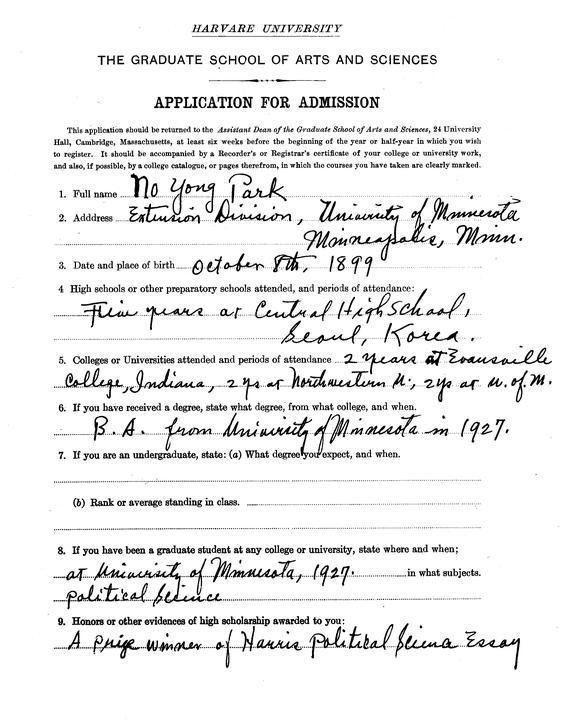
The first page of a handwritten application form to Harvard University by Park. Courtesy of Harvard University Archives.In 1910, Korea formally was annexed by Japan as a colony, sparking a flurry of activity among Korean intellectuals and activists who sought to retrieve independence. Park soon became deeply involved in organizing students for participation in the March First demonstrations in 1919, working closely with Kim Sŏng-su and the Buddhist activist Han Yong-un (1879–1944).10 Park was involved in Buddhist efforts to support the Korean independence movement and the Provisional Government in Shanghai.11 Park also joined the secret society *Hyŏksindan* (Society of Innovation), led by Kim Sang-ok, and published in Korean magazines such as *Kaebyŏk* (Dawn of Creation).12 Because of these activities, Park was sought after by the Japanese colonial authorities, although he was able to evade them.13
Park soon fled Korea in 1919 due to his political activities, sailing first to China and then the United States.14 After staying in major Chinese cities such as Tianjin, Nanjing, and Shanghai, Park went to first war-ravaged Europe and then arrived in New York in July 1920.15
**No-Yong Park in America**
While his autobiography now appears to have severely distorted his life before arrival in the U.S., most of the book is devoted to his adjustment to life in America after 1921 and provides a lens into the life that immigrants and foreign students endured.
Although immigration from Asia—especially China—to the U.S. was heavily restricted since the passage of the Chinese Exclusion Act in 1882, students were notably exempt from restrictions because of their potential value as highly trained workers, and later, because of their political value during World War II and the Cold War.16 Students and other exempted categories of Chinese immigrants “retained their legal rights of entry” even under the 1882 Law, which is likely the reason Park was able to travel back and forth between Asia and the U.S.17 It is unclear with which type of visa Park sailed to America, for he did not enroll in a university until several months after his arrival, but given his extensive educational career there, we can infer he was able to travel to the U.S. as a “Chinese” man through student credentials. Park carried a Chinese passport until his eventual adoption of American citizenship.18
After arriving in the U.S. through Ellis Island in New York harbor, Park struggled to adapt to American life. He found his way to a town called Bound Brook in New Jersey, where he was able to take up residence at a school affiliated with the “Church of the Pillar of Fire,” which was infamous for its open support for the Ku Klux Klan; Park suspected he was admitted in order to be made into a Chinese missionary.19 He found the routine of constant, enthusiastic prayer, and strict vegetarian diet disagreeable. He writes that his “first taste of American ‘civilization’ in New Jersey left \[him\] completely bewildered and disillusioned,” making him wonder if Americans “had any business other than praying, jumping, and singing.”20 Within a year, Park moved from New York to Chicago in the summer of 1922, and after a few more months, enrolled in Evansville College in Indiana sometime in the fall of 1922.21
Park’s first real experience in a college campus at Evansville induced culture shock and continued frustrations with the language barrier and gender relations.22 As one of the few, if only, Asian students there, he was often “an object of amusement and curiosity,”23 as well as a target of pranks, which were often based on taking advantage of his unfamiliarity with the language.24 He also struggled early on in classes but began to improve by his second year at the school.25 In addition, even after arriving in the U.S., Park contributed to the Korean journal *Kaebyŏk*, extolling the virtues of working while studying (*kohak*) in which most American students seemed to be engaged.26
While at Evansville, however, Park sowed the seeds of his future profitable career in lecturing, which he had begun to earn money for school. Despite his difficulty with English, he constantly practiced his speeches in his spare time. His first speech was about the U.S.’s potential positive role in Asia; Americans were uniquely qualified to be “a modern Moses” that would lead Asians to civilization because they had turned away from imperialism unlike other Western powers.27 He made a good impression and began to be invited to give his speeches, whether at churches or service clubs. Soon after he even began to receive payment for them, and his lecturing career took off.28 By 1923, Park had already gained a reputation as a distinguished speaker even to the point of being reported on by the Korean newspaper *Tonga ilbo* (East Asia Daily).29 Park joined the Chautauqua lecture circuit in 1924 after two years at Evansville College.30 He earned a high salary of 85 dollars a week, touring Canada during the summer of that year.31
Eventually, Park enrolled in Northwestern University, where he studied history and political science. While a student, he continued to give lectures in Chicago. Although he exhibited much academic promise, he encountered issues with the foreign language requirement.32 He transferred to the University of Minnesota as a result, where he received his B.A. in political science and international relations in 1927.33 Although Park mainly received middling grades at Minnesota, he mastered the English language to the point that he was winning prizes in writing and oratory as an undergraduate student.34 He lectured at the University of Minnesota’s Extension Division prior to moving to Cambridge to begin his studies at Harvard.
**Park’s Time at Harvard**
Enrolling at Harvard in February 1929 in the middle of the 1928–1929 academic year due to his busy lecturing schedule,35 Park went on to earn both his Master’s Degree (1930) and Ph.D. (1932) in political science and international relations at Harvard.36 Outside of some confusion over Park’s fulfillment of graduate requirements at Minnesota that initially caused the Harvard administration to deny him his Ph.D., Park had a respectable academic record there.37 Park’s dissertation was on China’s foreign relations focusing on the League of Nations.38
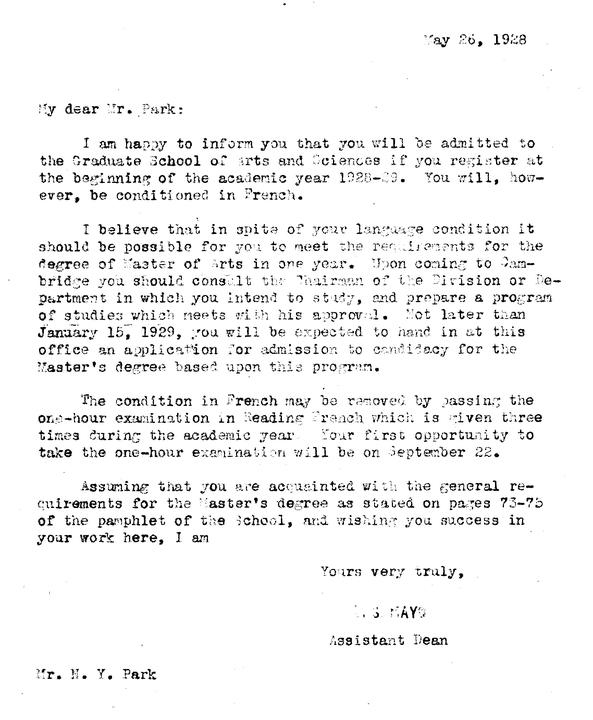
Park's admission letter to Harvard GSAS (May 26, 1928). Courtesy of Harvard University Archives.Park found the atmosphere at Harvard to be “very friendly and democratic,” despite the school’s reputation for “snobbishness.”39 Scholars whom Park befriended and studied under included the economist William B. Munro and the political scientist Arthur N. Holcombe.40 Park credited Holcombe, a modest man who owned a battered Model-T that Park thought was even worse for wear than his own, for imparting on him the lesson that intellectual and cultural cultivation were more important than worldly possessions.41 Indeed, the faculty were renowned for their amiability, as professors and even Presidents A. Lawrence Lowell and James Bryant Conant were well-known for inviting students to their homes for informal receptions.42
Park, like many past and future Harvard students, found the tuition to be exorbitant.43 Fortunately, with his personal and academic background in China, Park continued to give talks on Chinese issues as a graduate student.44 He was able to earn enough money for school through his continued lecturing activities.45 By this point, he was considered a “head-liner,” and earned enough such that lecturing once a week was enough to pay for graduate school.46
**Park as a Full-time Lecturer and Writer**
Upon graduation from Harvard, Park was once again left struggling to find work, this time due to the onset of the Great Depression. After teaching for a short while at Case Western Reserve University in Cleveland, Park devoted his time to lecturing and writing.47 Building upon his previous speaking experiences, Park became again a regular on the Chautauqua lecture circuit as well as the lyceums of the Rotary Clubs of America, concentrating his oratorial efforts on Asian issues.48 Park toured throughout the country at various venues, including town halls, private clubs, college campuses, and even dinner parties.49 Park was able to meet notable figures as a result of his growing fame as a lecturer, such as Secretary of State Henry L. Stimson and the pioneering American female aviator Amelia Earhart.50
Park’s informative and witty lectures proved popular among his audiences, which varied in composition, social class, and location. Due to his academic background and lucid communication of his thoughts, Park gained a reputation as an “authority” on the Far East.51 Despite his association with the Korean independence movement and his early motivation to spread the word about Korea’s plight,52 Park does not appear to have given much, if any, time to Korea in his lectures, focusing mainly on the burgeoning conflict between China and Japan based on his supposed credentials as a Chinese man. After the Manchurian Incident in 1931, in which the Japanese seized Manchuria after a railway explosion caused by an Imperial Japanese Army faction, Park began to call for concerted action against Japan by the U.S. and the West in his lectures, though to little effect.53 During World War II, Park traveled widely in the U.S. to give talks on the Sino-Japanese and Pacific Wars.54 By the war’s end and as the Cold War got under way, Pak was considered “one of America’s foremost authorities on affairs in the Far East.”55 Park continued to lecture on Asia until the end of his life.56
During one of his lectures, Park met, and later married, a Korean art student who was studying in the U.S., Lanhei Kim Park (Kim Nan-hŭi, née Kim Sun-bu, 1902–1996).57 Lanhei attended Ewha High School and Ewha College (later Ewha Womans University), where she had counted the later Ewha president Helen Kim (Kim Hwal-lan 1899–1970) as a close friend and teacher.58 No-Yong and Lanhei married in 1935 and raised two daughters, Chin-lan and Mei-lan.
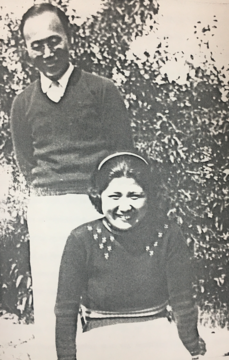
Photo of No-Yong and Lanhei Park (1936). Courtesy of Lanhei Kim Park and Mei-Lan Shaw.After American citizenship was expanded in 1953 to include Asian residents in the U.S., the Parks applied and received citizenship.59
Park also worked as a professor and lecturer at various universities, concentrating on Asian politics and history. He taught Chinese politics and Far Eastern studies at many institutes of higher education, including the University of Minnesota, Case Western Reserve University, the University of Kentucky, Northeast Missouri State College (now Truman State University), the University of Alabama, UC-Irvine, and UC-San Diego, while also serving as a special lecturer at the Institutes of International Understanding.60 A complete archive of Park’s works as well as materials related to Park can be found at Truman State University.61
Park stayed in good health for most of his life, although he suffered nervous breakdowns for several years in the 1950s.62 Park passed away in 1976. Until the end of his life, Park continued to identify himself as Chinese.63
**No-Yong Park: A Study in Immigrant Liminality**
No-Yong Park’s life story embodies the various liminalities or in-betweenness in identity that most immigrants experience to some degree: the feeling of belonging neither here nor there and the inability to truly assimilate. In Park’s case, there were multiple, competing layers of identity: Korean versus Chinese and assimilated Asian-American immigrant versus outside observer of America. For Park, this liminality was both forced upon him and also something he actively sought to enforce, both for personal and professional reasons.
It is unclear exactly why Park chose to represent himself as Chinese. It is also uncertain how fluent Park was in Chinese; Harvard documents show that Park listed Korean as his “native tongue” and claimed he had spent seven years learning Japanese and five in Chinese, but there is no indication what manner this language education was, or if he was referring to literary Chinese education.64 It is possible that he felt compelled to deny his Korean heritage because of political reasons. After all, he had been active in the Korean independence movement and fled Korea to avoid Japanese persecution.65 It is also possible that he felt he could not call himself Korean because Korea had lost its sovereignty and become a Japanese colony—although this is less convincing as the growing Korean-American community certainly was adamant about asserting its Korean-ness.
Whatever his reasons for choosing to call himself Chinese, once he did, he was relentless in asserting that identity. For instance, in a letter to a Mrs. Boyd while at the University of Minnesota, for instance, Park referred to himself as “the Chinese student who made you laugh so much the other day.”66 In another letter to a Mrs. Comiskey, he called himself a “heathen Chinaman.”67
To be sure, claiming Chinese background surely aided in his rise to prominence as an expert on Asian politics, especially with the emerging conflict between China and Japan in the 1930s. Indeed, Park’s daughter Chin-lan (Chinn Callan) speculated that Park claimed Chinese identity because of the “more prestigious fiction of being a scholar born and raised Manchurian” than Korean.68
In addition to the ambiguity of his Asian identity, Park was also caught in the liminal space that comes with being an immigrant. In addition to the inevitable instances of racial discrimination he and his family faced, Park was also confronted with the question of assimilation. In the beginning, Park desperately wanted to assimilate into mainstream American society. After his attainment of a Harvard degree, Park felt he “was an American in almost every way except in my physical appearance.” But there was nothing he could do about his appearance that would make him fit in with white American society despite his best efforts, as Park poignantly recounts in his autobiography.69 Park also keenly demonstrated his awareness of his uneasy status in American society in his retelling of his romance with a white American woman while in Minnesota. He constantly feared that she would be looked down upon for being in a relationship with an Asian man and hesitated to propose marriage because of his pessimism that an interracial marriage would surely “end in tragedy.”70
Despite these strictures, Park was able to take advantage of his unique place in American society and make a living and a name for himself. In his books and lectures, Park frequently categorized himself as an outsider to America that allowed him to advertise his analysis of American policy and society as being unique. He also saw himself—and expressed this idea in his writing—as someone who could bridge the gap in “Eastern” and “Western” customs and values. In that sense, Park took advantage of his liminality to position himself as a uniquely valuable voice in the vast sea of intellectuals active in America at the time.
On the whole, however, Park was largely complimentary of American society and politics despite any criticisms he may have leveled at them. When examining his early reports on life in America in Korean publications, his positive view of the U.S. reflected his constant concern about improving the situation of his homeland and his Korean “compatriots” (*tongp’o*) by using America and Americans as models to follow in the quest for development.71 In this regard, while Park himself may have been unique among Asian immigrants to the U.S. for his participation in an anticolonial independence movement, he was part of a broader historical trend of Asian intellectuals who looked to emulate the West for the improvement of their home societies. It is likely that this framework influenced Park’s positive views of America throughout his life, even as he quickly abandoned his Korean identity.
Park’s life story, especially upon his arrival in America, exemplifies both the structural constraints and discrimination imposed on immigrants as well as the vibrant agency of immigrants making their way in their new home countries.
Written by Sungik Yang, 6/10/2021
1 Despite Park listing his birth year as 1899 in *Chinaman’s Chance*, Wook-Dong Kim argues that it was actually 1897. Wook-Dong Kim, *Global Perspectives on Korean Literature* (Singapore: Springer Singapore Pte. Limited, 2019), 149–152.
2 Wook-Dong Kim, *Global Perspectives on Korean Literature*, 149–152.
3 Wook-Dong Kim, *Global Perspectives on Korean Literature*, 155.
4 Lanhei Kim Park (Kim Nan-hŭi) and Chinn Callan, *Facing Four Ways: The Autobiography of Lanhei Kim Park (Mrs. No-Yong Park)* (Oceanside, CA: Orchid Park Press, 1984), 144, 297; Wook-Dong Kim, *Global Perspectives on Korean Literature*, 154–155.
5 Wook-Dong Kim, *Global Perspectives on Korean Literature*, 157–158.
6 There is a slight difference in the Chinese character for “*min*” (玫) listed in news articles and that listed in the Korean history databases, but it is largely accepted that they are the same person, and that Pak Min-o is indeed No-Yong Park. For the database entry, see “3.1 tongnip undong kwa pulgyogye ŭi hang Il minjok undong” \[The March First Independence Movement and Buddhists’ Anti-Japanese Nationalist Movement\], *Hanminjok tongnip undongsa*, vol. 9. Accessed December 17, 2020. [http://db.history.go.kr/item/level.do?levelId=hdsr\_009\_0040\_0020\_0030](http://db.history.go.kr/item/level.do?levelId=hdsr_009_0040_0020_0030). For Korean news articles that claim the No-Yong Park-Pak Min-o connection, see “Habŏdŭ Tae ch’ŏt Han’gugin paksa nŭn sŭngnyŏ ch’ulsin tongnip undongga” \[First Korean to Receive Doctorate from Harvard was an Independence Activist with a Buddhist Monk Background\], *Pŏppo sinmun*, June 29, 2018. Accessed December 17, 2020. . This article erroneously states that Park was the first Korean PhD from Harvard, but that distinction belongs to Kyung Durk Har. See also “Pulgyo hang-Il undong, kŭ hyŏnjang ŭl kada, 11, Tongnip undong chiwŏnhan Okch’ŏnsa” \[We Go to the Scene of the Buddhists’ Anti-Japanese Movement, 11, Okch’ŏn Temple, Which Supported the Independence Movement\], *Pulgyo sinmun*, July 10, 2018. Accessed December 17, 2020. .
7 Wook-Dong Kim, *Global Perspectives on Korean Literature*, 152.
8 Lanhei Kim Park, *Facing Four Ways*, 144, 297; Wook-Dong Kim, *Global Perspectives on Korean Literature*, 156. Park also listed “Central High School” as his alma mater in his application to Harvard. See “No Yong Park, Application for Admission, Harvard University Graduate School of Arts and Sciences,” Student folder for No Young Park, UAV 161.201.11 Box 56, Harvard University Archives, pp. 34–36. "No Young Park" is the spelling of Park's name in his student folder at the Harvard University Archives. Hereafter, this archival source will be noted as “Student folder for No Young Park” in newly cited documents from that source, along with the page number. For further details on Kim Sŏng-su, his brother Kim Yŏn-su, and their company Kyŏngbang Spinning and Weaving Company, which became the largest Korean business in colonial Korea, see Carter J. Eckert, *Offspring of Empire: The Koch’ang Kims and the Colonial Origins of Korean Capitalism, 1876–1945* (Seattle: University of Washington Press, 1991).
9 Lanhei Kim Park, *Facing Four Ways*, 293, 297.
10 Lanhei Kim Park, *Facing Four Ways*, 295; Wook-Dong Kim, *Global Perspectives on Korean Literature*, 157.
11 “Sŭngnyŏ Sin Sang-wan i Chongno Kyŏngch’alsŏ e ch’ep’o toeda” \[Buddhist Monk Sin Sang-wan Was Arrested at Chongno Police Station\], *Ilche ch’imnyak ha Han’guk 36 nyŏnsa*, vol. 5, April 6, 1920. Accessed February 16, 2021. [https://db.history.go.kr/modern/level.do?levelId=su\_005\_1920\_04\_06\_0400](https://db.history.go.kr/modern/level.do?levelId=su_005_1920_04_06_0400).
12 Wook-Dong Kim, *Global Perspectives on Korean Literature*, 158–160.
13 See “Chōsen dokuritsu undōsha no kenkyo” \[Arrests of Korean Independence Activists\], May 12, 1921. Accessed February 16, 2021. [https://db.history.go.kr/modern/level.do?levelId=haf\_118\_0630](https://db.history.go.kr/modern/level.do?levelId=haf_118_0630)
14 “Chae Mi Chosŏn haksaeng ŭi sunhoe kangyŏn” \[Lecture Tour of Korean Student Residing in America\], *Tonga ilbo*, April 17, 1923.
15 See Pak No-yŏng, “Miguk haksaeng ŭi charipsŏng” \[The Self-Reliance of American Students\], *Kaebyŏk* No. 12 (June 1921), 82–85. [http://db.history.go.kr/item/level.do?levelId=ma\_013\_0120\_0140](http://db.history.go.kr/item/level.do?levelId=ma_013_0120_0140). See also No-yong Park, *Chinaman’s Chance: An Autobiography* (Boston: Meador Publishing Company Publishers, 1940), 17; Wook-Dong Kim, *Global Perspectives on Korean Literature*, 160–161.
16 See Madeline Y. Hsu, *The Good Immigrants: How the Yellow Peril Became the Model Minority* (Princeton; Oxford: Princeton University Press, 2015).
17 Hsu, *The Good Immigrants*, 13. Park periodically returned to Asia throughout his life, partly in order to stay up to date on developments on the continent for his lectures and books. According to Lanhei Kim Park’s autobiography, Park actually returned to his hometown in Korea at least once in 1930, but had to flee the peninsula for China to evade arrest. See Lanhei Kim Park, *Facing Four Ways*, 238, 288. The couple was also wary of any travel back to Korea due to the threat of arrest by the Japanese. See Lanhei Kim Park, *Facing Four Ways*, 166.
18 No-Yong Park, *Chinaman’s Chance*, 45–46. In addition, Lanhei Kim Park appears to have sailed to America on a student visa, as she first went to the U.S. to attend UCLA and then mentioned having to be in school by a certain time to comply with U.S. immigration laws. See Lanhei Kim Park, *Facing Four Ways*, 117, 172. She mentions the difficulties of obtaining her passport to travel to the U.S. to attend UCLA; she writes: “In those days Korea was under the control of the Japanese colonial government. It was very difficult to obtain a passport to leave the country, especially to go to America.” See Lanhei Kim Park, *Facing Four Ways*, 117.
19 No-yong Park, *Chinaman’s Chance*, 19. For more on the Pillar of Fire Church’s association with the KKK, see Lynn S. Neal, “Christianizing the Klan: Alma White, Branford Clarke, and the Art of Religious Intolerance,” *Church History*, Vol. 78, No. 2 (June 2009): 350–378; Kristin E. Kandt, “In the Name of God, an American Story of Feminism, Racism, and Religious Intolerance: The Story of Alma Bridwell White,” *The American University Journal of Gender, Social Policy, and the Law*, Vol. 8, No. 3 (June 2000): 753–794.
20 No-yong Park, *Chinaman’s Chance*, 21.
21 No-Yong Park, *Chinaman’s Chance*, 22–25.
22 No-Yong Park, *Chinaman’s Chance*, 26–33.
23 No-Yong Park, *Chinaman’s Chance*, 26.
24 These included taking Park to a “snipe-hunt,” in which the target of the prank is led to the countryside to catch nonexistent birds called “snipe,” causing him or her to lie in wait for hours before discovering the truth of the matter. See No-Yong Park, *Chinaman’s Chance*, 28–29.
25 He received mostly C’s in his first year in subjects such as English, History, and Sociology, but his grades improved to mostly B’s the next year. See “Evansville College Transcript,” Student folder for No Young Park, p. 13.
26 See Pak No-yŏng, “Miguk haksaeng ŭi charipsŏng.” Another essay Park wrote for *Kaebyŏk* discussed the reasons for American economic development, locating American economic success not merely in plentiful material resources but also the character of the American people. See Pak No-yŏng, “Miguk ŭi pu rŭl sogae haya pon’guk tongp’o ŭi kaksŏng ŭl ch’okham” \[One Must Introduce America’s Wealth to Speed Up the Waking of Our Compatriots\], *Kaebyŏk* No. 11 (May 1921), 52–57. [http://db.history.go.kr/item/level.do?levelId=ma\_013\_0110\_0070](http://db.history.go.kr/item/level.do?levelId=ma_013_0110_0070).
27 No-Yong Park, *Chinaman’s Chance*, 37.
28 No-Yong Park, *Chinaman’s Chance*, 34–42; “Chae Mi Chosŏn haksaeng ŭi sunhoe kangyŏn,” *Tonga ilbo*, April 17, 1923.
29 “Chae Mi Chosŏn haksaeng ŭi sunhoe kangyŏn."
30 It does not appear that he earned a degree at Evansville based on Park’s application to Harvard GSAS. See “No Yong Park, Application for Admission, Harvard University Graduate School of Arts and Sciences,” Student folder for No Young Park, pp. 34–36.
31 No-Yong Park, *Chinaman’s Chance*, 43–46. By comparison, in an essay he wrote for *Kaebyŏk*, Park notes that the average tuition of top American universities ranged from 3–400 dollars (7–900 dollars when including room and board), so the payments Park received were substantial. See Pak No-yŏng, “Miguk haksaeng ŭi charipsŏng.”
32 Northwestern at the time required all students to also pass both French and German; Park was willing to study one of them, but not both, since Park, as a foreign student, was already spending much time learning English. Northwestern would not allow him to substitute Chinese or Japanese for one of the two European languages. See No-Yong Park, *Chinaman’s Chance*, 48.
33 Park’s graduation from the school was delayed when he hit a snag with an I.Q. test—designed for natural-born American citizens—which put him at below the required level for students. See No-Yong Park, *Chinaman’s Chance*, 54–55.
34 “University of Minnesota Transcript for No Yong Park,” Student folder for No Young Park, pp. 9–10; No-Yong Park, *Chinaman’s Chance*, 48, 54; “Specialist on Far East to Lecture on Korea War,” *Los Angeles Times*, July 17, 1950; “Distinguished Alumni: Park No-Yong,” University of Minnesota, . The essay with which he won the Harris Political Science Essay Contest in 1925 while at Northwestern was on the subject of Japanese Exclusion. See No-Yong Park, *Chinaman’s Chance*, 48.
35 “Letter from Assistant Dean G. K. Zipf,” November 24, 1930, Student folder for No Young Park, p. 18; Letter from No Yong Park to L. S. Mayo, July 28, 1928. Student folder for No Young Park, p. 37.
36 Wook-Dong Kim, *Global Perspectives on Korean Literature*, 147.
37 “Letter from the Assistant Dean to Park,” February 17, 1932, Student folder for No Young Park, p. 12; “Letter from Dean Guy Stanton Ford to Dean Lawrence S. Mayo,” February 23, 1932, Student folder for No Young Park, p. 7; “Letter from No Yong Park to Dean Lawrence S. Mayo,” February 24, 1932, Student folder for No-Yong Park, p. 6; “Letter from Assistant Dean to No-Yong Park,” March 4, 1932, Student folder for No Young Park, p. 5; “Letter from G. H. Chase to Arthur E. Norton,” July 17, 1935, Student folder for No Young Park, p. 1.
38 No-Yong Park, “China in the League of Nations: A Chapter on China’s Foreign Relations,” Ph.D. Diss., 1932.
39 No-Yong Park, *Chinaman’s Chance*, 59.
40 No-Yong Park, *Chinaman’s Chance*, 59–62.
41 No-Yong Park, *Chinaman’s Chance*, 61–62.
42 No-Yong Park, *Chinaman’s Chance*, 62–63.
43 As noted above in footnote 31, Park wrote in *Kaebyŏk* that the average tuition of Ivy League universities including Harvard were around 300 to 400 dollars (700 to 900 dollars when including room and board). See Pak No-yŏng, “Miguk haksaeng ŭi charipsŏng.”
44 “China to Continue as League Member: Chinese Student Gives Talk on Nation’s Problems,” *Daily Boston Globe*, March 29, 1929.
45 We can assume that Park received a comparable sum as when he lectured while an Evansville student, which was around $85 a week. No-Yong Park, *Chinaman’s Chance*, 43–46.
46 No-Yong Park, *Chinaman’s Chance*, 63–64.
47 No-Yong Park, *Chinaman’s Chance*, 69–83. See Bibliography for a complete list of Park’s written works in English.
48 No-Yong Park, *Chinaman’s Chance*, 43, 104. The Chautauqua lectures, in fact, turned out to be one of the primary means by which Americans were exposed to the issue of Korea, as speakers such as Homer B. Hulbert and Stephen A. Beck, longtime advocates for Korea, toured the country appealing to their audiences for the cause of Korean independence. See David P. Fields, *Foreign Friends: Syngman Rhee, American Exceptionalism, and the Division of Korea* (Lexington: The University Press of Kentucky, 2019), 73–77.
49 No-Yong Park, *Chinaman’s Chance*, 84–106.
50 No-Yong Park, *Chinaman’s Chance*, 84–85, 120; Lanhei Kim Park, *Facing Four Ways*, 196–197.
51 “Beth Israel Forum to Hear Dr. No-yong Park Talk on Japs,” *Chicago Daily Tribune*, December 12, 1943.
52 “Chae Mi Chosŏn haksaeng ŭi sunhoe kangyŏn.”
53 No-Yong Park, *Chinaman’s Chance*, 107–111.
54 No-Yong Park, *Chinaman’s Chance*, 112–118.
55 “Authority on Far East Is Speaker,” *The Austin Statesman*, January 12, 1959. See also “Specialist on Far East to Lecture on Korea War.”
56 Nancy Neff, “Humorist Warns of ‘Nutty’ Professors and the Red Chinese,” *The Austin American Statesman*, January 22, 1976.
57 Lanhei Kim Park states that she was twelve years old in 1914. See Lanhei Kim Park, *Facing Four Ways*, 35. For Lanhei Kim Park’s original name, see Wook-Dong Kim, *Global Perspectives on Korean Literature*, 150.
58 Lanhei Kim Park, *Facing Four Ways*, 54, 286.
59 Hsu, *The Good Immigrants*, 127; Lanhei Kim Park, *Facing Four Ways*, 251–252.
60 “Specialist on Far East to Lecture on Korea War,” *Los Angeles Times*, July 17, 1950.
61 For more information on the No-Yong Park Papers, see [http://library.truman.edu/manuscripts/P4-Park\_Papers.asp](http://library.truman.edu/manuscripts/P4-Park_Papers.asp).
62 Lanhei Kim Park, *Facing Four Ways*, 243–255.
63 Nancy Neff, “Humorist Warns of ‘Nutty’ Professors and the Red Chinese.”
64 See “No Yong Park, Application for Admission, Harvard University Graduate School of Arts and Sciences,” Student folder for No Young Park, p. 34–36. There was also an incident when Chinese residents in Canada confronted Park. Park could not understand them because they spoke in Cantonese. This does not, however, preclude his fluency in Mandarin. See No-Yong Park, *Chinaman’s Chance*, 45–46.
65 However, as seen above in the Korean-language articles he wrote about his days as a student in American colleges, Park did not hide his presence in the U.S. during the first few years of his life. Moreover, it is possible Park continued to maintain links with the independence movement to some degree, as Lanhei Kim Park notes that members of the Hŭngsadan, the U.S.-based Korean independence movement founded by An Ch’ang-ho, and followers of Syngman Rhee attended at least one of Park’s lectures. See Lanhei Kim Park, *Facing Four Ways*, 141.
66 See “Letter to Mrs. Boyd,” February 24 (year unknown), Student folder for No Young Park, p. 29–31.
67 See “Letter to Mrs. Comiskey,” date unknown, Student folder for No Young Park, p. 27.
68 Chinn Callan, “Editor’s Preface,” in Lanhei Kim Park, *Facing Four Ways*, xviii.
69 No-Yong Park, *Chinaman’s Chance*, 151.
70 No-Yong Park, *Chinaman’s Chance*, 52, 55.
71 For instance, see Pak No-yŏng, “Miguk ŭi pu rŭl sogae haya pon’guk tongp’o ŭi kaksŏng ŭl ch’okham.”
---
**Bibliography**
Park had a prolific writing career in English. **His English-language publications include:**
Park, No-Yong. *Making a New China*. Boston: The Stratford Company Publishers, 1929.
Park, No-Yong. “China in the League of Nations: A Chapter on China’s Foreign Relations,” Ph.D. Diss., Harvard University, 1932.
Park, No-Yong. *An Oriental View of American Civilization*. Boston; New York: Hale, Cushman & Flint, 1934.
Park, No-Yong. *Retreat of the West: The White Man’s Adventure in Eastern Asia*. Boston; New York: Hale, Cushman & Flint, 1937.
Park, No-Yong. *Chinaman’s Chance: An Autobiography*. Boston: Meadow Publishing Company Publishers, 1940.
Park, No-Yong. *The White Man’s Peace: An Oriental View of Our Attempts at Making World Peace*. Boston: Meador Publishing Company Publishers, 1948.
Park, No-Yong. *A Squint-Eye View of America*. Boston: Meador Publishing Company Publishers, 1951.
Park, No-Yong. *Long Time No See: Lectures*. New York: Exposition Press, 1967.
**Park’s writings in Korean include:**
Pak No-yŏng. “Miguk ŭi pu rŭl sogae haya pon’guk tongp’o ŭi kaksŏng ŭl ch’okham” \[One Must Introduce America’s Wealth to Speed Up the Waking of Our Compatriots\]. *Kaebyŏk* No. 11 (May 1921), 52–57. [http://db.history.go.kr/item/level.do?levelId=ma\_013\_0110\_0070](http://db.history.go.kr/item/level.do?levelId=ma_013_0110_0070).
Pak No-yŏng. “Miguk haksaeng ŭi charipsŏng” \[The Self-Reliance of American Students\]. *Kaebyŏk* No. 12 (June 1921), 82–85. [http://db.history.go.kr/item/level.do?levelId=ma\_013\_0120\_0140](http://db.history.go.kr/item/level.do?levelId=ma_013_0120_0140).
**For more on Park and his family’s lives, see also:**
Lanhei Kim Park (Kim Nan-hŭi) and Chinn Callan. *Facing Four Ways: The Autobiography of Lanhei Kim Park (Mrs. No-Yong Park)*. Oceanside, CA: Orchid Park Press, 1984.
**Archival materials related to No-Yong Park include the following collections:**
Student Folder for No Young Park, UAV 161.201.11 Box 56, Harvard University Archives, Harvard University. Courtesy of the Harvard University Archives.
No-Yong Park Papers, Ms Collection P4, Special Collections University Archives, Truman State University. [http://library.truman.edu/manuscripts/P4-Park\_Papers.asp](http://library.truman.edu/manuscripts/P4-Park_Papers.asp)
**For academic treatments of No-Yong Park and his works, please refer to the following:**
Han, John J. “A Beacon of Hope or Not: No-Yong Park’s Mixed Vision of America.” *Journal of Ethnic American Literature*, Issue 5 (2015): 59–73.
Kim, Wook-Dong. *Global Perspectives on Korean Literature*. Singapore: Springer Singapore Pte. Limited, 2019.
Moncovich, Anna Mary. “‘Forming Good Citizens’: The Function of American Immigrant Autobiographies, the Reader and the Myths of the Nation.” Ph.D. Diss., University of California, Irvine (2010).
**Other secondary works cited:**
Eckert, Carter J. *Offspring of Empire: The Koch’ang Kims and the Colonial Origins of Korean Capitalism, 1876–1945*. Seattle: University of Washington Press, 1991
Fields, David P. *Foreign Friends: Syngman Rhee, American Exceptionalism, and the Division of Korea*. Lexington: The University Press of Kentucky, 2019.
Hsu, Madeline Y. *The Good Immigrants: How the Yellow Peril Became the Model Minority*. Princeton; Oxford: Princeton University Press, 2015.
Kandt, Kristin E. “In the Name of God, an American Story of Feminism, Racism, and Religious Intolerance: The Story of Alma Bridwell White.” *The American University Journal of Gender, Social Policy, and the Law*, Vol. 8, No. 3 (June 2000): 753–794.
Neal, Lynn S. “Christianizing the Klan: Alma White, Branford Clarke, and the Art of Religious Intolerance.” *Church History*, Vol. 78, No. 2 (June 2009): 350–378.
**From the Korean History Database:**
“3.1 tongnip undong kwa pulgyogye ŭi hang Il minjok undong” \[The March First Independence Movement and Buddhists’ Anti-Japanese Nationalist Movement\], *Hanminjok tongnip undongsa*, vol. 9. Accessed December 17, 2020. [http://db.history.go.kr/item/level.do?levelId=hdsr\_009\_0040\_0020\_0030](http://db.history.go.kr/item/level.do?levelId=hdsr_009_0040_0020_0030).
“Chōsen dokuritsu undōsha no kenkyo” \[Arrests of Korean Independence Activists\], May 12, 1921. Accessed February 16, 2021. [https://db.history.go.kr/modern/level.do?levelId=haf\_118\_0630](https://db.history.go.kr/modern/level.do?levelId=haf_118_0630)
“Sŭngnyŏ Sin Sang-wan i Chongno Kyŏngch’alsŏ e ch’ep’o toeda” \[Buddhist Monk Sin Sang-wan Was Arrested at Chongno Police Station\], *Ilche ch’imnyak ha Han’guk 36 nyŏnsa*, vol. 5, April 6, 1920. Accessed February 16, 2021. [https://db.history.go.kr/modern/level.do?levelId=su\_005\_1920\_04\_06\_0400](https://db.history.go.kr/modern/level.do?levelId=su_005_1920_04_06_0400)
**Newspaper Articles:**
“Authority on Far East Is Speaker,” *The Austin Statesman*, January 12, 1959.
“Beth Israel Forum to Hear Dr. No-yong Park Talk on Japs,” *Chicago Daily Tribune*, December 12, 1943.
“Chae Mi Chosŏn haksaeng ŭi sunhoe kangyŏn” \[Lecture Tour of Korean Student Residing in America\], *Tonga ilbo*, April 17, 1923.
“China to Continue as League Member: Chinese Student Gives Talk on Nation’s Problems,” *Daily Boston Globe*, March 29, 1929.
“Habŏdŭ Tae ch’ŏt Han’gugin paksa nŭn sŭngnyŏ ch’ulsin tongnip undongga” \[First Korean to Receive Doctorate from Harvard was an Independence Activist with a Buddhist Monk Background\], *Pŏppo sinmun*, June 29, 2018. Accessed December 17, 2020. .
Neff, Nancy. “Humorist Warns of ‘Nutty’ Professors and the Red Chinese,” *The Austin American Statesman*, January 22, 1976.
“Pulgyo hang-Il undong, kŭ hyŏnjang ŭl kada, 11, Tongnip undong chiwŏnhan Okch’ŏnsa” \[We Go to the Scene of the Buddhists’ Anti-Japanese Movement, 11, Okch’ŏn Temple, Which Supported the Independence Movement\], *Pulgyo sinmun*, July 10, 2018. Accessed December 17, 2020. .
“Specialist on Far East to Lecture on Korea War,” *Los Angeles Times*, July 17, 1950.
**Other Websites:**
“Distinguished Alumni: Park No-Yong,” University of Minnesota, .
*The Harvard Korean Alumni Biographies Project and the Project website are copyright © 2024 President and Fellows of Harvard College and/or its licensors. Unauthorized reproduction or distribution is not permitted.* *Please contact Executive Director Susan Laurence (*[*susan\_laurence@harvard.edu*](mailto:susan_laurence@harvard.edu)*) for any concerns or questions*.
- ## Decade
[1930-1940](/decade/1930-1940)
- ## Korean Alumni
[Graduate School of Arts and Sciences](/korean-alumni-decade/gsas)