
Samuel H. Kim

Samuel Homer Kim’s Senior Portrait in the 1958 Harvard College Yearbook. From Harvard University, Harvard College Yearbook (Cambridge, MA: Published by the University, 1958).
Samuel Homer Kim (Kim Sang-yŏl 김상열, 1936–present) was one of the earliest second-generation Korean Americans to have graduated from Harvard College and Harvard Medical School.[1] He went on to have a long, productive career in medicine as a pediatric surgeon (pediatric urology) at Massachusetts General Hospital in Boston from 1970 until his retirement in 2003.
Kim was born on September 11, 1936, in Boston, Massachusetts. His parents had moved to the United States from Korea, which was a colony of Japan between 1910 and 1945, during the 1920s in order to study abroad. His mother, Ruth Aigyung Kim (Ruth Chew Kim, Ch’u Ae-gyŏng 秋愛卿, 1900–1973), grew up in Taegu located in North Kyŏngsang Province. Her name was originally Ch’u Tong-am; she changed her name to Ae-gyŏng upon entering college.[2] From her early teenage years, Ch’u attended the Taegu Cheil Church (大邱第一敎會, The First Presbyterian Church of Daegu), which was the first Protestant church established in the area by American missionaries in the 1890s.[3] Her education continued to be intertwined with institutions connected to American Protestant missions as she discovered and cultivated her talent in singing. Ch’u attended the prestigious missionary-run women’s college, presently called Ewha Womans University, majoring in voice as a soprano and graduating in 1925. She moved to Japan for further training as a pianist at Kwassui Women’s University (活水女子專門學校) in Nagasaki with the goal of studying abroad in the United States.[4] The prominent American evangelist and music director, Homer A. Rodeheaver, took note of Ch’u’s talents and decided to sponsor her education in the United States. Ch’u became one of the eight Korean and Japanese students whose education was supported by Rodeheaver.[5] Before her journey to the United States, Ch’u returned to her hometown to perform a farewell concert to a large crowd hosted on the Taegu Cheil Church grounds in the summer of 1927. Once in the United States, Ch’u first attended the University of Washington and then the New England Conservatory, graduating in 1933.[6] On top of her career in singing, Ch’u published a gripping novel about a Korean family’s saga set during the colonial period titled The Family of Chung Song in 1968. The novel appears to be fictional, although the names of the family members seem to be the same as those in real life, including that of the titular character Tong-am.[7]
Kim’s father, Homer Tehsoor Kim (Kim T’ae-sul 김태술 金泰術, 1899–1979), was also a native of Taegu.[8] Kim and Ch’u were not only from the same hometown, but also close acquaintances from having attended Taegu Cheil Church together since their teenage years.[9] Kim was also talented in singing so they became good friends within the larger church community. After completing his secondary education in Taegu, Kim moved to P’yŏngyang to attend Union Christian College (합성숭실대학 合成崇實大學), the predecessor of current-day Soongsil University, which was set up by American Protestant missionaries in 1897.[10] While he was in college, Kim was arrested by the colonial police for printing copies of the Independence Declaration during the March First Movement in 1919 and sentenced to one year and six months in jail.[11] After completing his sentence, Kim graduated from college in 1921 and returned to Taegu to teach at his alma mater, Taegu Kyesŏng Hakkyo (대구계성학교). In 1924, Kim moved to the United States to study abroad after gaining admission to a college in the Midwest.[12] His education in the United States was also sponsored by Rodeheaver. In fact, Kim was the first of the eight students, which included Ch’u, whom Rodeheaver supported over the years.[13] Kim ended up adopting Rodeheaver’s first name, Homer, as his own.[14] After attending the University of Washington, Kim transferred to Massachusetts Institute of Technology as a junior, graduating in 1929 as an electric engineering major and notable athlete active in the varsity soccer and tennis teams. Prior to his collegiate athletic career, Kim was already well-known nationally as a skilled soccer and baseball player in Korea.
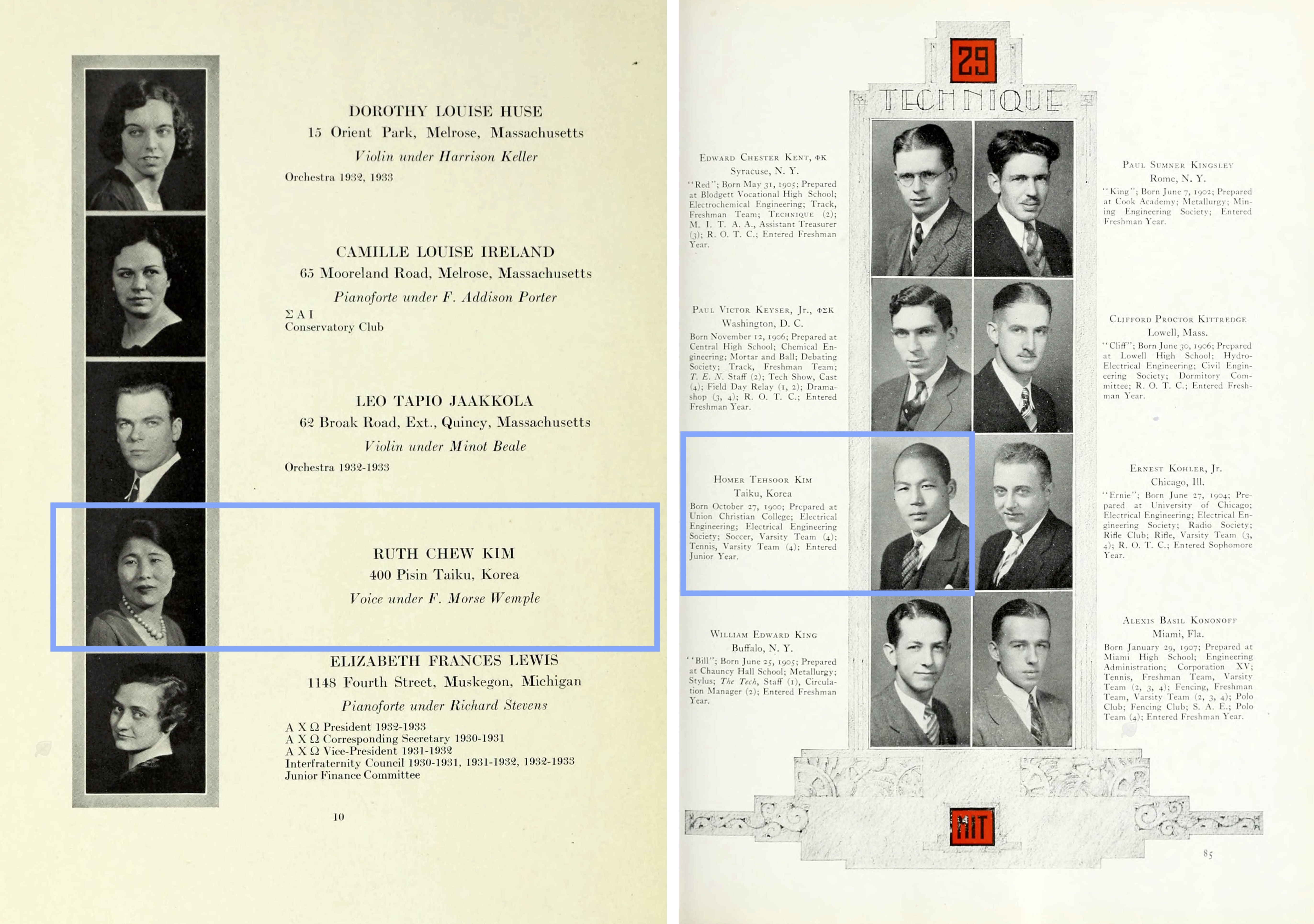
Although they arrived in the United States at different times, Ch’u and Kim crossed paths frequently due to their shared passion in singing, ties with Rodeheaver, and the fact that they were from the same hometown.[15] They participated in singing competitions held across the country together, such as the summer music conference held at Winona Lake in Indiana hosted by Rodeheaver in 1927 right after Ch’u arrived in the United States.[16] They eventually wed in 1928 and settled down in the suburbs of Boston thereafter.[17]
The Boston and Cambridge area in the thirties and forties had an extremely small community of Koreans consisting largely of students. Families, like the Kims, were even fewer in number. Song Hyung-nai, whose biography is available here, recounted befriending the Kims when he attended the Harvard School of Public Health between 1945–1946. According to Song, there was another family living in the Boston area at the time: the Paiks.[18] The two families’ hospitality and camaraderie helped Song settle into his life at Harvard and manage his longing for home while enriching his experience in the Boston area. The Kims took Song to watch symphony performances, and they gathered in Chinatown to eat Asian food.[19] Along with helping scholars and students from Korea ease into their lives in Boston and Cambridge, the Kims and Paiks supported the Korean team that traveled to Boston to compete in the 1947 Boston Marathon.[20] The Kims and Paiks provided the team with funds and helped out with the daily on-the-ground aspects of preparing for the race. Runner Sŏ Yun-bok (서윤복 徐潤福, 1923–2017) won the race, breaking the previous world record that was set by his coach, Son Ki-jŏng (손기정 孫基禎, 1912–2002), in the 1936 Summer Olympics held in Berlin.[21] In addition to setting a new men’s world record, Sŏ was the first Asian champion of the Boston Marathon. His teammate, Nam Sŭng-nyong (남승룡 南昇龍, 1912–2001), who won the bronze medal in the 1936 Olympics, came in twelfth place.
At the time of the marathon, Samuel Kim was around eleven years old. He had grown up in the Watertown area when not only Koreans, but also Asians and Asian Americans were few in the Boston area. He was, in many ways, part of the earliest cohort of second-generation Korean Americans. Kim graduated from Watertown High School and moved across the Charles River to attend Harvard College. After his freshman year in the yard, Kim became a member of the Winthrop House. He concentrated in biology and participated in diverse extracurricular activities, such as house sports (soccer, wrestling, and tennis), Phillip Brooks House, and Demo Lay. He was, in particular, committed to musical extracurriculars as an avid horn player for the Harvard Band and Schneider’s Band. In 1955, he was appointed as one of the four assistant Band managers.[22] Kim graduated in 1958 with cum laude honors for biology.[23]

Kim continued onto Harvard Medical School, graduating in 1962.[24] He began his general surgical residency at Boston City Hospital after earning his medical degree, but took leave in order to serve in the United States Air Force for two years from 1964 to 1966. After serving in South Korea, Japan, and California as a captain in the United States Air Force Medical Service Corps, Kim returned to Boston to continue his general surgical residency. During these busy years between the military and medicine, Kim married Barbara Maciel, who was a nurse, in 1966. When Kim completed his general surgical residency in 1969, he moved to England for his pediatric surgical residence at Alder Children’s Hospital in Liverpool.

Kim joined Massachusetts General Hospital’s Pediatric Surgical Department in 1970 when the department itself was in a stage of expansion. Two years prior to Kim’s arrival, the Pediatric Surgical Department had been given more space for laboratory work in a research building adjacent to the Bulfinch Building.[25] With the addition of Kim and later, Dr. Patricia Donahoe, the department increased its personnel as well. Kim was interested primarily in the treatment of congenital abnormalities in children, specializing in pediatric urology over the years.[26] Along with his role as a surgeon and teacher, Kim published his research widely in medical journals with over twenty publications related to pediatric urology and surgery.[27] Kim’s role at MGH further expanded to include administrative and leadership positions when he served as the president of the Massachusetts General Physicians Corporation (the predecessor of the Massachusetts General Physicians Organization) from 1993 to 1995.[28] Outside of his professional life, Kim continued to stay connected with Harvard in many ways, including his continued support for the Harvard University Band and Harvard Athletic Association. He also served as the treasurer of the Harvard Medical Alumni Association, later helping organize the Twenty-fifth Reunion of the Harvard Medical School’s Class of 1962.[29]
After a rich career of surgery, research, and teaching, Kim retired from medicine in 2003. According to his colleagues, Kim became a pillar of surgery at MGH as a devoted surgeon and teacher to students over the course of his thirty-four-year long career.[30] Following his retirement, he has been traveling and enjoying tennis, golf, photography, and other hobbies.[31]
Written by Sujin Elisa Han, 7/31/2024
Endnotes
[1] This biography is based primarily on the notes submitted by Samuel H. Kim in the alumni reports located in the main reading room of the Harvard University Archives. Kim sent in detailed, thoughtful, and often humorous updates about his personal life, career, and family for every alumni report, which began with the Harvard College Class of 1958 Sexennial Anniversary Report published in 1964. We would like to thank the Harvard Medical School’s Francis A. Countway Library of Medicine for providing a digital copy of the Class of 1962 photograph.
[2] For more on Ch’u’s life, see her biography published by the Boston University School of Theology’s Boston Korean Diaspora Project. “Chu Ae-Gyeong, Vocalist,” Boston University School of Theology: Boston Korean Diaspora Project, https://sites.bu.edu/koreandiaspora/individuals/boston-in-the-1920s/chu-ae-gyeong-vocalist/.
[3] Ch’u began going to church because she wanted to attend a missionary-run school for female students in Taegu called Sinmyŏng Girl’s School (신명여학교). Church attendance was required for the school’s students. For more on the church’s history, see “Taegu Cheil Kyohoe” [Taegu Cheil Church] in Han’guk minjok munhwa taebaekkwa sajŏn [Encyclopedia of Korean Culture]. https://encykorea.aks.ac.kr/Article/E0014133.
[4] Kwassui Women’s University was founded by an American Methodist missionary, Elizabeth Russell, in 1879. “Kwassui History,” Kwassui Women’s University, http://kwassui-int.ac.jp/profile-kwassuihistory/.
[5] Homer A. Rodeheaver, Twenty years with Billy Sunday (Nashville, TN: Cokesbury Press, 1936), 85.
[6] Ch’u has been regarded by current-day historians and scholars as the first female vocalist (sŏngakka) from the Kyŏngsang region (or Yŏngnam) in the southeastern part of South Korea. “Yŏngnam chiyŏk ch’oech’o ŭi yŏsŏng sŏngakka Ch’u Ae-gyŏng” [The First Female Vocalist from the Yŏngnam Region] in Kil ŭl mandŭn Kyŏngbuk yŏsŏng [The Women of Kyŏngbuk Who Paved the Way], ed. Kang Yun-jŏng, Kim Myŏng-hwa, Yi Yŏng-ran, Chŏng Il-sŏn, Ch’oe Mi-hwa, and Ch’oe Kyŏng-hwa (Kyŏngbuk Yŏsŏng Chŏngch’aek Kaebalwŏn) (Taegu: Wŏnk’ŏm, 2013), 72-81. An online copy of the entire publication is available here.
[7] Ch’u’s family was known as the Chung Song (Ch’ŏngsong) household, hence the title. The novel provides a fascinating glimpse into the trials and tribulations of individuals and a family as they grappled with Japanese colonial rule and the shift from social and cultural conventions of the past to those of the present and future throughout the 1910s to 1940s. Ruth Kim, The Family of Chung Song (New York: Vantage Press, 1968).
[8] In the Korean-language articles and webpages about Kim, his birth year is listed as 1899, which this biography follows. In the MIT yearbook, however, it is noted as 1900. The reason for this discrepancy is not known.
[9] For more on Ch’u and Kim’s lives, see “Ch’u Ae-gyŏng, Kim T’ae-sul, Kwŏn Yŏng-hwa, kŭdŭl ŭn nuguin’ga?” [Ch’u Ae-gyŏng, Kim T’ae-sul, Kwŏn Yŏng-hwa, who are they?], Ŭmak munhŏnhak 1 (2010): 249–288.
[10] “Soongsil University” [Sungsil Taehakkyo] in Han’guk minjok munhwa taebaekkwa sajŏn [Encyclopedia of Korean Culture]. https://encykorea.aks.ac.kr/Article/E0032077.
[11] For his involvement in the March First Movement and imprisonment, Kim has been posthumously awarded the Order of Merit for National Foundation (National Medal) by the South Korean government in 2017. More information about Kim’s activities during the March First Movement is available here. This webpage notes Kim’s birthplace as P’yŏngyang rather than Taegu; this seems to be a mistake. The article cited above about Kim identifies Taegu as his birthplace based on school records and other historical material.
[12] According to this 1924 article announcing Kim’s travel to the United States, it is presumed that Kim attended the University of Dubuque, a private Presbyterian university in Dubuque, Iowa. The article noted Kim was traveling to Ohio (오아이호), but this may have been a mistake. It is unclear if Kim attended this university. “Kim T’ae-sul kun to-Mi” [Mr. Kim T’ae-sul leaving to America 金泰述君渡米], Tonga ilbo, March 25, 1924.
[13] Rodeheaver, Twenty years with Billy Sunday, 85.
[14] Rodeheaver, Twenty years with Billy Sunday, 85.
[15] It is not clear if their time at the University of Washington overlapped.
[16] Scholars have described this 1927 event as a national singing competition based on newspaper articles published in Korea at the time. It turns out the event was actually hosted by Rodeheaver and tied to his broader mission of promoting evangelical music. Three Koreans participated in the 1927 event: Ch’u, Kim, and Hyŏn Che-myŏng (현제명 玄濟明, 1902–1960) who became a famous composer and professor after he returned to Korea. All three were from Taegu and sponsored by Rodeheaver to study in the United States. This conference overlapped in time and place with the 33rd Winona Lake Bible Conference, which was an outdoor revival gathering held annually in the Lake area. Ch’u, Kim, and Hyŏn can be found in the group photograph taken during the 33rd Bible Conference in the center seated around Rodheaver. The photograph, provided by Grace College’s Digital Library, can be viewed through this link.
[17] This date is from Ch’u’s biography in Kil ŭl mandŭn Kyŏngbuk yŏsŏng, which provides details about her wedding’s location, date, and officiator. Her page on BU’s Boston Korean Diaspora Project notes she was married in 1930.
[18] The father and husband of the Paiks was named Norman Y. Paik.
[19] Song recounted his time with the Kims and Paiks in his memoir (in section 10-6) published online on a family website run by his nephew, Mr. Sae Kim. Song Hyŏng-nae, “Memoir of Dr. Henry Hyung Rae Song, M.D.” Sae R. Kim’s Family Home Page (in “Family” section). Original memoir completed on May 13, 2000. http://www.saekim.net/Saekim/Family/Song/Memoir/memoir-cover.html.
[20] A South Korean film, Road to Boston (보스톤 1947), released in 2023 depicts the Korean team’s trials and tribulations leading up to Sŏ’s victory in the 1947 Boston Marathon. The film features a fictionalized version of Norman Paik (백남용) due to lack of information about Paik and does not feature Kim. The official history of the Korean Church of Boston, however, notes Homer T. Kim also helped support the Korean team. For more information, see Posŭt’on Hanin Kyohoe 60 nyŏnsa P’yŏngch’an Wiwŏnhoe, Posŭt’on Hanin Kyohoe 60 nyŏnsa, 1953–2013 [A 60-Year Pilgrimage of the Korean Church of Boston: 1953–2013] (Brookline, MA: Posŭt’on Hanin Kyohoe, 2015), 112. This history is also available online (here) on the Korean Church of Boston’s website.
[21] Sŏ’s victory was particularly momentous for Korea because it was the first time a Korean individual competed and won in an international race after the country was liberated from Japanese colonial rule. Although Son won in the 1936 Berlin Olympics, his gold medal was recorded under Japan due to Korea’s status as a colony. At the time of the 1947 Boston Marathon, Korea was divided at the 38th parallel and occupied jointly by the Soviet Union in the north and United States in the south between 1945–1948. Since southern Korea was under American military rule at the time, the two Korean runners, Sŏ and Nam ran with uniforms bearing both the United States Army Military Government in Korea (USAMGIK) and Korean flags.
[22] “Dills, Ernst Named To Band Positions,” The Harvard Crimson, November 22, 1955. https://www.thecrimson.com/article/1955/11/22/dills-ernst-named-to-band-positions/.
[23] Two individuals whose biographies are featured on the Korean Alumni Biographies Project, Kwangjai Park and Youngil Lim, graduated in 1958 as well.
[24] Dr. Andrew Ho Kang, whose biography is available here, graduated in 1962 as well.
[25] “History of Urology at Massachusetts General Hospital,” Massachusetts General Hospital, https://www.massgeneral.org/urology/about/history.
[26] The information in this paragraph draws on Kim’s submission to the Harvard Class of 1958 Twenty-fifth Anniversary Report published in 1983. His report was longer and more detailed than previous entries due to the importance of this anniversary. Kim’s entry can be found on page 450 of the report.
[27] A comprehensive list of Kim’s publications is available on this webpage.
[28] Nan Zheng, “Is John H. McArthur the Most Powerful Man at Harvard?” The Harvard Crimson, June 9, 1994.
[29] Kim noted his role in the Harvard Medical School reunion in his report for the Harvard Class of 1958 30th Anniversary Report published in 1988.
[30] W. Hardy Hendren, “Pediatric Surgery at the Massachusetts General Hospital Looking Back Half a Century, and Further,” The Massachusetts General Hospital Surgical Society Newsletter vol. 9, issue 2 (2008): 7-8. https://www.massgeneral.org/assets/mgh/pdf/surgery/surgical-society/fall_2008.pdf
[31] This last section is from Kim’s most recent submission to the Harvard College Class of 1958 Sixty-fifth Anniversary Report published in 2023.